Posts

Showing posts with the label graphic novels

what i'm reading: political graphic nonfiction: this place: 150 years retold
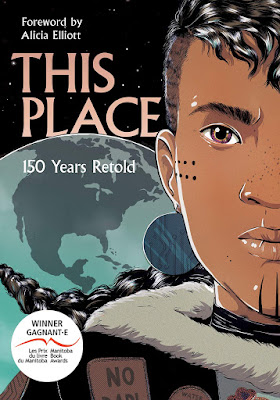
Image
This Place: 150 Years Retold , foreward by Alicia Elliott. In keeping with my posts about political graphic nonfiction , here is a quote from This Place . The book is an anthology of 10 stories by 10 or 11 writers and illustrators. Each writer prefaces their story with context, including something about their personal connection to the material. Chelsea Vowel  begins her preface to "kitaskinaw 2350" like this. Dystopian or apocalyptic writing occupies an enormous amount of space in contemporary storytelling and in our social consciousness. We are told that the end is nigh, and that the world (or at least the world as we know it) will be destroyed, and that this is a Bad Thing. We are encouraged to imagine what life could be like during and after this supposedly inevitable destruction, but are steered away from dreaming up alternatives. Indigenous peoples have been living in a post-apocalyptic world since Contact. This entire anthology deals with events post-apocalypse! * * * ...

what i'm reading: political graphic nonfiction: wobblies, studs terkel's working, people's history of american empire

Image
Continuing the series, started here . I've decided not to review these books, but instead to post a cover image and a quote. It was difficult to choose quotes for these books, since they are books about ideas and events, with hundreds of different people quoted and referenced. After flipping through the books and seeing quote after beautiful, stirring, inspiring, infuriating quote, I decided to pull the lens back to more general thoughts from introductions and prefaces. Wobblies!: A Graphic History of the Industrial Workers of the World , edited by Paul Buhle and Nicole Schulman (many contributors) The world of the Wobs was made up of immigrant workers without steady employment, health plans, social security or drug benefits (like the future that Republicans and many a Democrat envision), without any responsibility on the part of the filthy rich for the growing class of poor -- so much like the society around us today. The world of the Wobblies was one realized in its best moments ...

what i'm reading: political graphic nonfiction: biographies of emma goldman, muhammad ali, and eugene v. debs

Image
I have been collecting graphic nonfiction with leftist political themes. I just love these books and am indulging myself in buying them. I was planning to review them, but I've decided to simply post images of the covers, the names of the books and the creators, and a quote from the person, group, or idea the book is about. Dangerous Woman: A Graphic Biography of Emma Goldman , written and illustrated by Sharon Rudahl, edited by Paul Buhle The greatest bulwark of capitalism is militarism. The very moment the latter is undermined, capitalism will totter. True, we have no conscription; that is, men are not usually forced to enlist in the army, but we have developed a far more exacting and rigid force--necessity. Is it not a fact that during industrial depressions there is a tremendous increase in the number of enlistments? The trade of militarism may not be either lucrative or honorable, but it is better than tramping the country in search of work, standing in the bread line, or slee...

what i'm reading: graphic adaptation of anne frank's diary

Image
Diary of a Young Girl , by Anne Frank, is many things to many people. It's the most widely read and recognizable Holocaust narrative. It's one of the most common ways to teach young people about the Holocaust specifically and genocidal in general. It's a book for all ages. I read it as a child, as a teen, and as an adult, and I understood it on different levels at different times of my life -- and that's probably a common experience. If you haven't re-read the Diary as an adult, I highly recommend it. The Diary has been translated into 70 languages and more than 25 million copies have been printed worldwide. It continues to be read in schools all over the world. This is partly because the first-person account personalizes the experience, makes it relatable, in a way that conventional histories cannot. But I believe the impact of the Diary endures because Anne was such a talented writer . This fact is often overlooked in discussions of the Diary, overshadowed by t...

"at your library" column in the north island eagle: let your reading take you someplace new

Let Your Reading Take You Someplace New Many of you already appreciate the joys of reading. Reading transports us to other worlds and lets us vicariously experience other lives. Reading helps us feel less alone, knowing there are other people who struggle with the same issues we do. Reading helps us explore questions of ethics, morality, spirituality, politics, and culture. It's been shown that people who read have more empathy and compassion than people who don't. That makes sense, because when we read, we are putting ourselves in others' shoes, which is literally the definition of empathy. If you love to read, why not challenge yourself to read something different? This year, I encourage you to try reading read three books that are outside your usual comfort zone. In the next few "At Your Library" columns, I will suggest a few tips on taking your reading in a different direction. Thousands of words in every picture Many adults have not yet discovered the joys of...

things i heard at the library: an occasional series: #29

Image
It's TIHATL, Summer Reading Club edition! Summer Reading Club is in full swing in Canadian libraries. In more than 2,100 libraries around Canada, kids are earning prizes and recognition for reading. Thanks to Toronto Public Library and a certain sponsoring bank, we all have lots of free stuff to give away. The most popular kids' series ever, still going strong after almost 15 years. Our motives are simple: kids who read during the summer do better in school in September. SRC also helps remind parents of pre-readers to read with their little ones daily. Our children's library is very  busy. The first day of SRC, we signed up 180 kids! After two weeks, we're well over 600 participants. When kids register, or when they come in to "report" and collect prizes, it's a great time for some one-on-one conversations with our young customers. Some won't say one word without their parents' prompting, but others are so forthright and articulate! It's reall...

what i'm reading: rolling blackouts, graphic novel that asks many big questions

Image
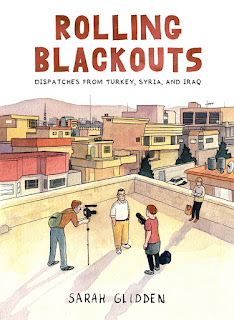
I see by the wmtc tag "graphic novels" that I intended to write about graphic books I read and enjoyed...and I see by the scant number of posts with that tag that I have not been doing so! The last wmtc post tagged for graphic novels is from four years ago , almost to the day. In any event, I want to tell you about a graphic book I just finished and really enjoyed: Sarah Glidden's Rolling Blackouts: Dispatches from Turkey, Syria, and Iraq . In 2010, Glidden traveled with three friends who had journalism visas to the three countries in the book's title. Two of the three were part of a nonprofit, progressive media collective; the third was a former US Marine who served in the Iraq War, and was a childhood friend of one of the journalists. Glidden doesn't merely report on what they found -- which would be interesting in itself. She stands outside the frame, as it were, and writes about their process and all its implications -- the ethics of their interviews, the indu...

what i'm reading: four classic graphic novels for adults who think they don't like graphic novels

Image
Despite the increased attention given to graphic novels in recent years, many readers don't consider graphic novels when thinking about what to read next. In this "what i'm reading" post, I highlight four graphic novels considered classics of the form. At least three of these books are included on high school and university curricula, and taken seriously as literature. These are certainly not the only graphic novels to achieve that standing, but if you asked a bunch of non-graphic-fiction readers to name some well-known and influential graphic novels, these would likely top the list. Each is worth reading, and perhaps will lead you to explore the format. (Or not.) First on any such list has to be Maus (now known as Maus I: My Father Bleeds History ). Art Spiegelman is the godfather of the modern graphic novel, and this book, first published in 1986, might be his best work. It is a foundational work of graphic fiction, and a definitive work of the Holocaust. Maus  is b...

what i'm reading, children's books edition: # 8: the invention of hugo cabret

Image
In the aftermath of the flood and with our impending move, when I'm not dealing with those events, all I want to do is read and blog. If you enjoy my "what i'm reading" posts, you'll be happy. If not... * * * * I've long wanted to read The Invention of Hugo Cabret by Brian Selznick. Now that Martin Scorsese has adapted it into the movie "Hugo," I wanted to make sure I read it before seeing the film. The Invention of Hugo Cabret is a wonderfully inventive and engaging book. It combines elements of picture books, graphic novels, and even flip books within the "chapter book" format for older children. It's a big, fat book - which itself has appeal for many readers - but roughly half the pages are filled with black-and-white pencil illustrations. These are pencil drawings, also by Selznick. Typically, a group of illustrations form a sequence of images, first seen from a distance, then zooming in closer, and still closer. Because of this t...

what i'm reading, children's books edition: # 4

Image
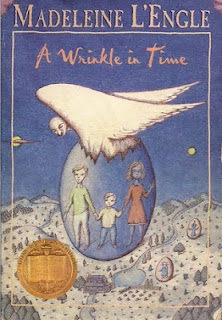
Still Classic? A Wrinkle in Time , Madeleine L'Engle, 1962 A Wrinkle in Time has always been one of my favourite books. Although I have re-read it a few times over the years, I approached it for this series with some trepidation, a bit concerned that I might no longer recommend it to young readers. I needn't have worried. The book - continually in print since it was first published in 1962 - was reissued last year in a special 50th anniversary printing, and with very good reason. From the moment we begin, we are drawn to Meg - confused and frustrated, feeling like she can't do anything right. Scrappily defending her odd younger brother. Clinging to her mother's calm faith that her father will return. Feeling destined to never fit in. And as we're identifying with Meg, the mystery begins to unfold. Who is this strange Mrs. Whatsit, and how does she know a secret about Meg's mother, one that even Meg didn't know? Family bonds, the pressures of conformity, an...